My own productStarted October 2026, pre-pilot
An assistant coach that remembers every student
Coaches who run small group sessions plan tonight's courts in their heads and keep each student's progress in memory. I started CourtPlan to carry both. It is pre-pilot, with no users and no revenue yet. This page covers the problem, the field, the design, and how I'll test demand before writing production code.
Stage
Pre-pilot
A clickable prototype exists; production code waits for a two-week hand-run test.
Design target
Under 2 min
A design target for coach effort per session, not a measured result.
Price hypothesis
$15–30
A price hypothesis of $15–30 per coach a month, tested in Phase 0.
How I built it. I did the market research, the competitive scan, the design brief and the clickable prototype solo with Claude Code.
I paused AnswerClip, my earlier idea, because its demand check came back too thin, and moved to a problem two coach friends who run small group sessions face.
Why this, why now, why me
Why this problem
Three jobs no single tool handles together
Coaches with 2 to 12 students on 1 to 4 courts plan tonight's session in their heads at the fence, 5 minutes before start. Each student's progress lives in memory and gets lost after two missed weeks. Progress updates keep students paying, yet rarely get sent. This is my hypothesis from the 2 pilot coaches; Phase 0 interviews check it against their last sessions.
Why now
A voice note can become a record
Transcription and structured LLM output can turn a 60-second voice note into one entry per student. An LLM limited to the coach's own drill library can draft a plan, while code enforces the court and grouping rules. The coach talks; the software files.
Why me
Two pilot coaches and a fast build loop
I'm an engineer turned PM who builds solo with Claude. Two coach friends who run small group sessions are lined up as my pilots, and they already shaped the product: fee tracking came from them.
I scanned 12 tools: they know who booked, not what to run
Features and prices as seen on October 13, 2026. A selection of the 12 tools scanned.
| Tool | What it does | What it misses |
|---|---|---|
| Outcoach | Journal, parent app, voice-to-text, fee processing and bookings for tennis coaches. | No session planner found. The biggest threat if it adds one. |
| Booking tools (CourtReserve, Playbypoint) | Court bookings and payments for clubs. | Nothing about what to run on court or how each student is doing. |
| CoachNow | Video coaching with plan templates. | No plan built from tonight's attendance and courts. |
| Sportplan, PracticePlanner | Drill libraries and practice plans for teams. | No attendance, court split or memory of each student. |
| WhatsApp, Sheets and Venmo | The free default: messages, a spreadsheet and payment apps. | All manual and scattered. Progress is lost when a student skips. |
| ChatGPT and other chat assistants | Drafts a session plan on request. | No roster, attendance, court rules or memory between sessions. |
| CourtPlan | Turns attendance and courts into a plan from the coach's own drills, a voice note into a journal, and tracks fees after class. | No bookings, payments, student app or video, by design. |
The open space is planning plus memory: attendance and courts turned into groups and drills from the coach's own library, and a journal that remembers. No bookings to migrate, so it sits beside existing tools.
Market size, bottom-up: coaches times price
TAM
~$75M
Total market (TAM): about 215k racquet coaches worldwide (ITF and PPR counts, plus a padel estimate from FIP club counts) at $29 a month, the top of my $15–30 price hypothesis, gives ~$75M a year.
SAM
~$12M
US serviceable market (SAM): about 35k US certified tennis and pickleball pros (USPTA, PTR and PPR) at $29 a month gives ~$12M a year.
SOM
~$0.7M
Year-3 obtainable market (SOM): ~$0.7M a year. This is an assumption, not a forecast.
The biggest unknown is the share of coaches who run small groups. There is no public data, so I'll ask in the Phase 0 interviews. All three use $29 a month, the top of my price hypothesis, so treat them as upper bounds.
The design: one loop, four moments
Before
Attendance becomes a plan
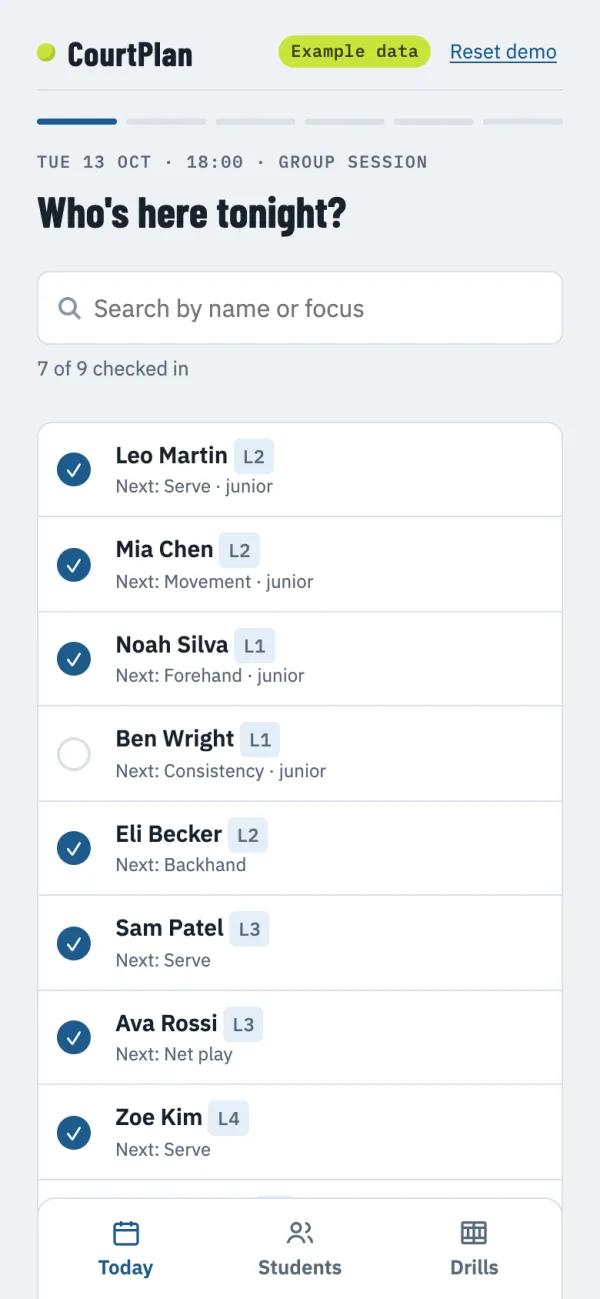
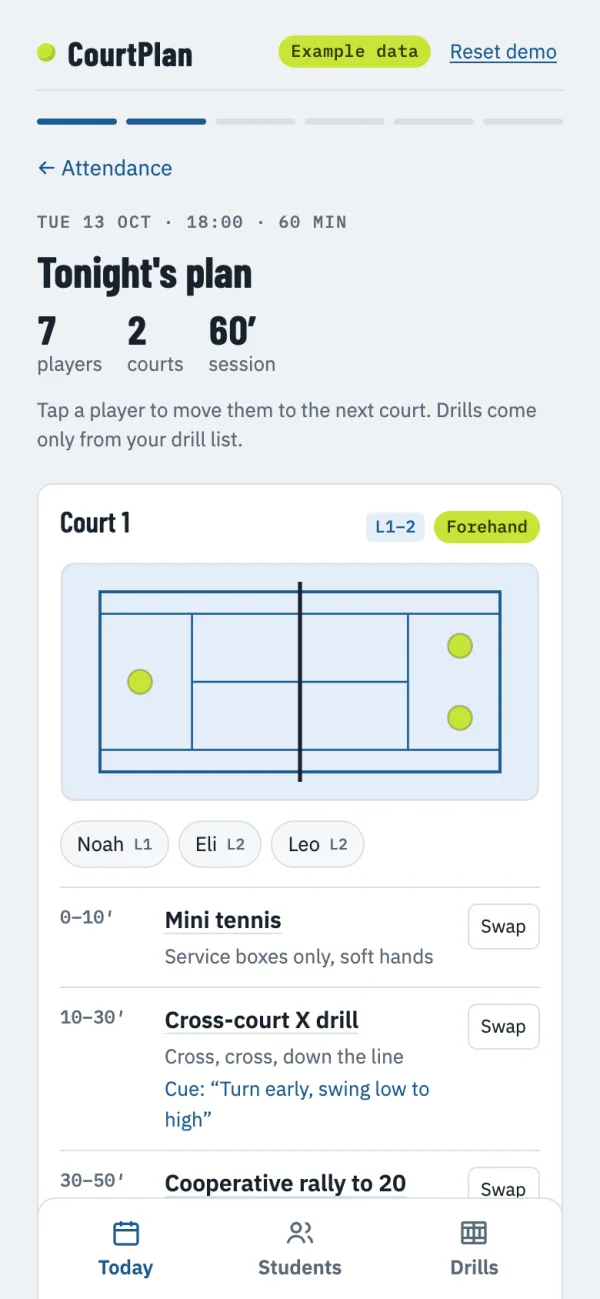
The coach taps who showed up and how many courts there are. CourtPlan splits groups by level and picks drills from the coach's library for each court.
On court
A timer runs the session
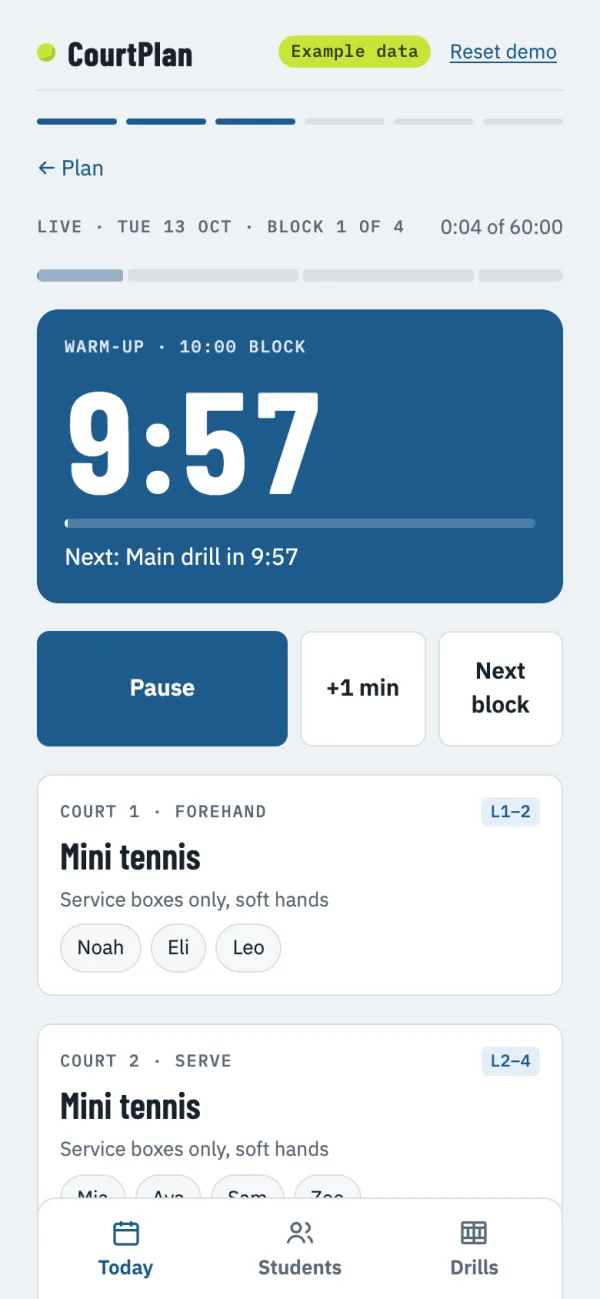
A live timer counts down each block and shows the drill and cue for every court. One tap adds a quick note on a player.
After
A voice note becomes the journal
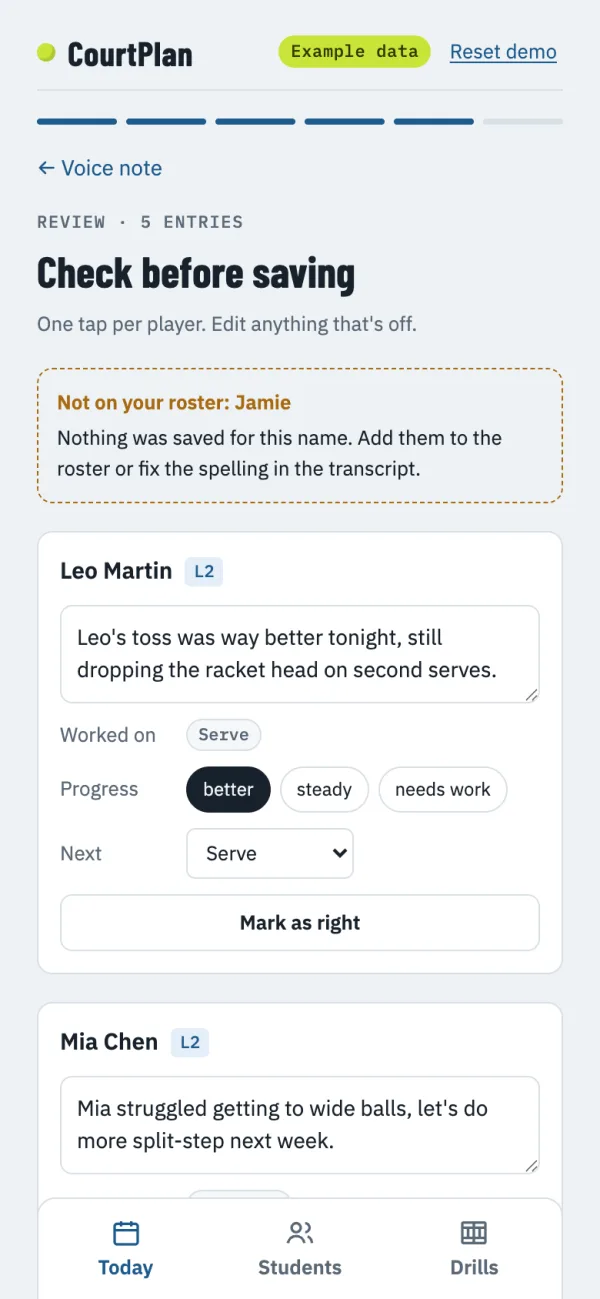
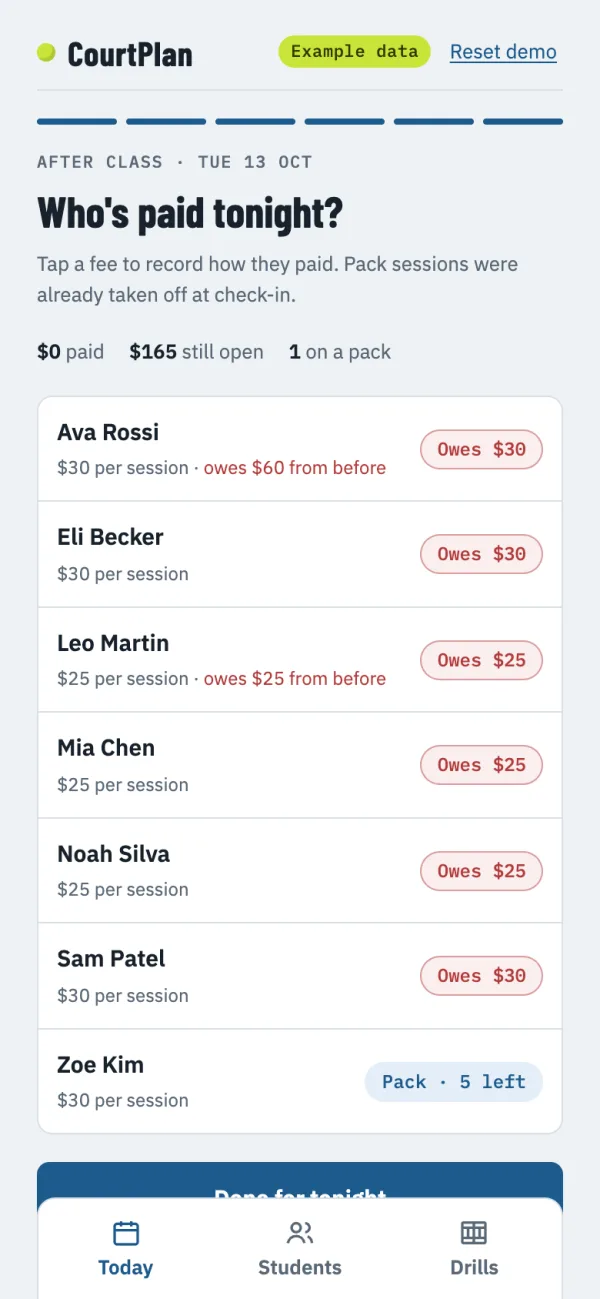
A 60-second voice note becomes one entry per student, which the coach checks before saving. Then fees are recorded, one tap per student: Venmo, Zelle, cash, a pack or not paid yet.
Monthly
Progress notes the coach approves
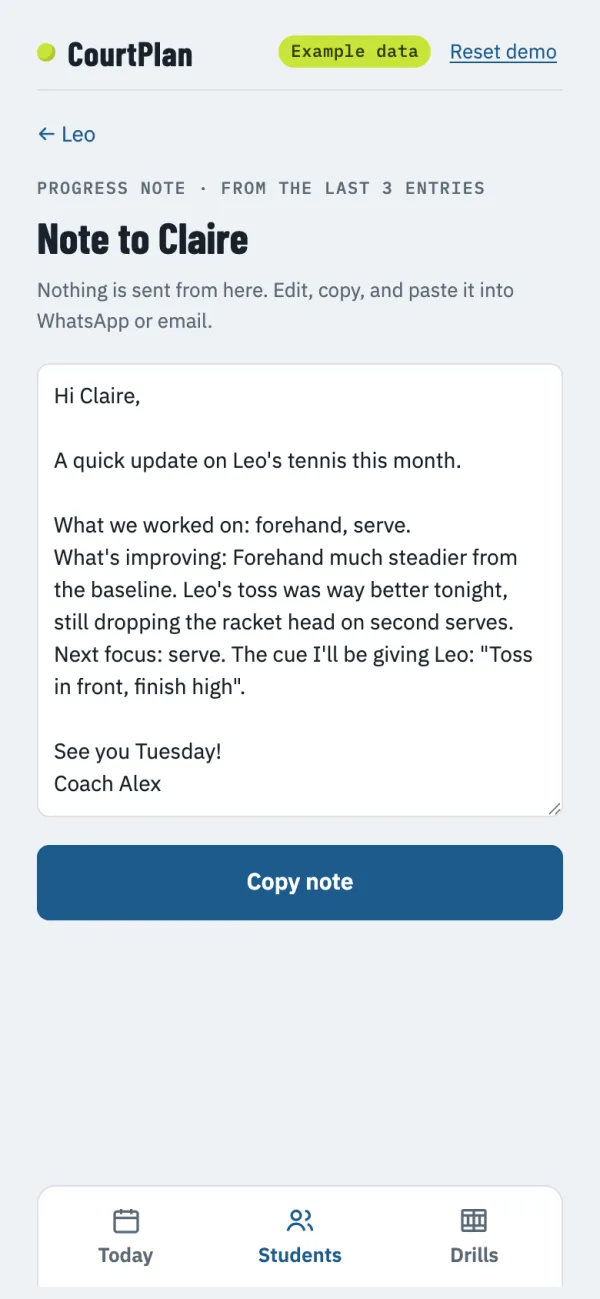
CourtPlan drafts a short note per student from the journal. The coach edits and approves it, then sends it to the student or parent.
Design target: under 2 minutes of coach effort per session, one-handed on a phone. It is a target, not a result.
Code keeps the rules, the LLM drafts, the coach decides
Each step is labeled by who does it: code, the LLM or the coach. Nothing goes out without the coach's approval.
Voice note to journal
Planner
- Fees are tracked, never processed. Venmo and cash stay as they are.
- The LLM only picks from the coach's own drills.
- Code, not the LLM, enforces courts and groups.
- Nothing is sent to a student or parent without the coach's approval.
Planned stack: a Next.js phone web app on Vercel, Supabase for data and audio, OpenAI transcription, Claude Sonnet for structured JSON and Resend for email.
Six screens from the prototype
Screens from a clickable prototype with example data. The students, groups and fees are made up.
How I'll find out if anyone wants it
Phase 0: I am the product for two weeks
Before any production code, I plan sessions and write journals by hand for the 2 pilot coaches. Friends tend to be polite, so interviews ask about their last session, not my idea, and the test is judged on behavior. It passes if they send attendance and voice notes without reminders and name a price.
- Next
Phase 0
Concierge testCoaches send attendance and voice notes on their own and name a price. If I have to chase them, it fails.
- Later
Phase 1
JournalCoaches log their own sessions, and most drafted entries need no edits.
- Later
Phase 2
PlannerCoaches run the generated plan, with light edits, in most sessions.
- Later
Phase 3
Progress updatesEach coach sends notes, and a student or parent replies; the coach says the note was worth sending.
- Later
Phase 4
DecideI ask the pilot coaches to pay. Then I decide to charge and grow, or stop. Any failed gate means stop and decide.
North star. Sessions per week where the coach both planned and logged.
| Risk | How I handle it |
|---|---|
| Friends being polite | Concierge test first, judged on what the coaches do, not what they say. |
| Coaches won't log after class | A 60-second voice note, no forms. |
| Wrong names in voice notes | Roster nicknames, flagged unmatched names and a review screen before saving. |
| Nonsense drills | The LLM only picks from the coach's own drills, and code enforces the court rules. |
| A crowded category | Win on the planner, which I found no sign of in Outcoach, built from the coach's own drills and attendance. Stay out of bookings. |
| A small market | The same loop fits other small-group teaching beyond racquet sports, such as swim and music lessons. |