My own productv0.2 preview, live demo
Pocket Tennis Team: a personal tennis coaching team on Claude
It runs on the player's computer today; phone capture and access are next, hence "Pocket". No real players have used it yet.
Players get advice from lessons, YouTube, teammates and parents, and keep almost none of it. I designed and built a Head Coach and six specialists, seven AI team members, each a Claude skill (a packaged set of instructions Claude follows): you talk after practice, the team remembers, and you get a small plan where every item says why.
Coach reply time
About 3 min to about 20 s
The time until the coach replies, measured in my own end-to-end tests with the live AI. Bookkeeping still runs in the background afterwards.
The team
7 members
Seven team members, each a Claude skill with its own job and rules, behind one conversation with a Head Coach.
Voice
36 voices
Natural on-device voices, English and Chinese, so the coach's replies are spoken back.
A pro has a team. A club player has none.
The problem
Advice from everywhere, a plan from nowhere
Club and junior players hear from lessons, YouTube, teammates and parents. Almost none of it is remembered, connected or turned into a plan. A pro has a coach, an analyst, a fitness coach and someone tracking every match. A club player has none of that.
Sam, 44, adult player
"If I have to type it, I won't."
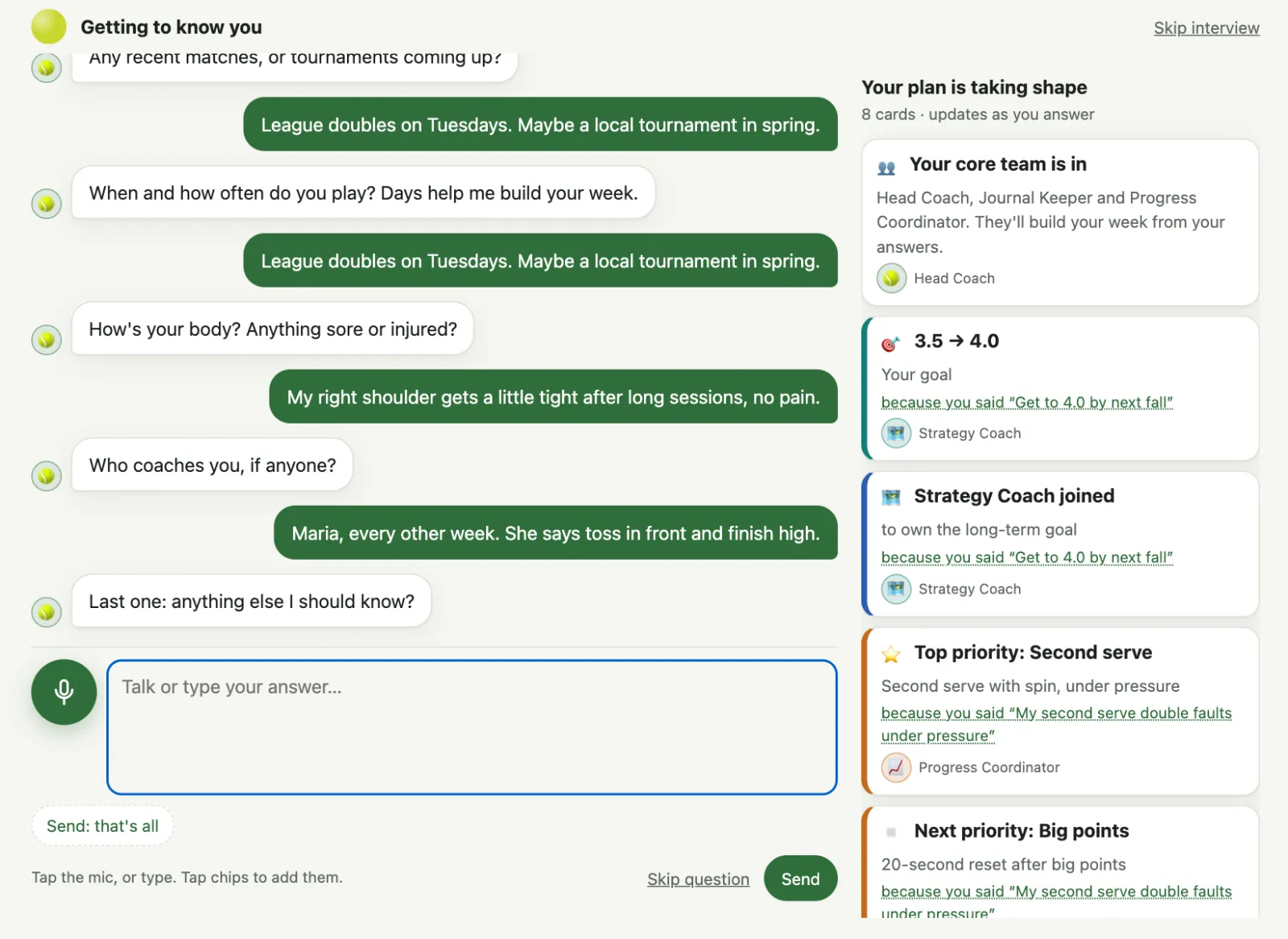
Sam plays for fun and will never open a spreadsheet. So I made it voice first: Sam talks after practice or a match, and the team turns that into a training diary and a small plan.
Mei, 46, parent of Alex, 14
"Tell me what to say in the car, and what not to."
Mei runs it for Alex, a competitive junior. She isn't the player, so she gets entry deadlines, load and body checks, and help with the talk after a match.
The rules every screen follows, and what each one costs
A coach, not a dashboard
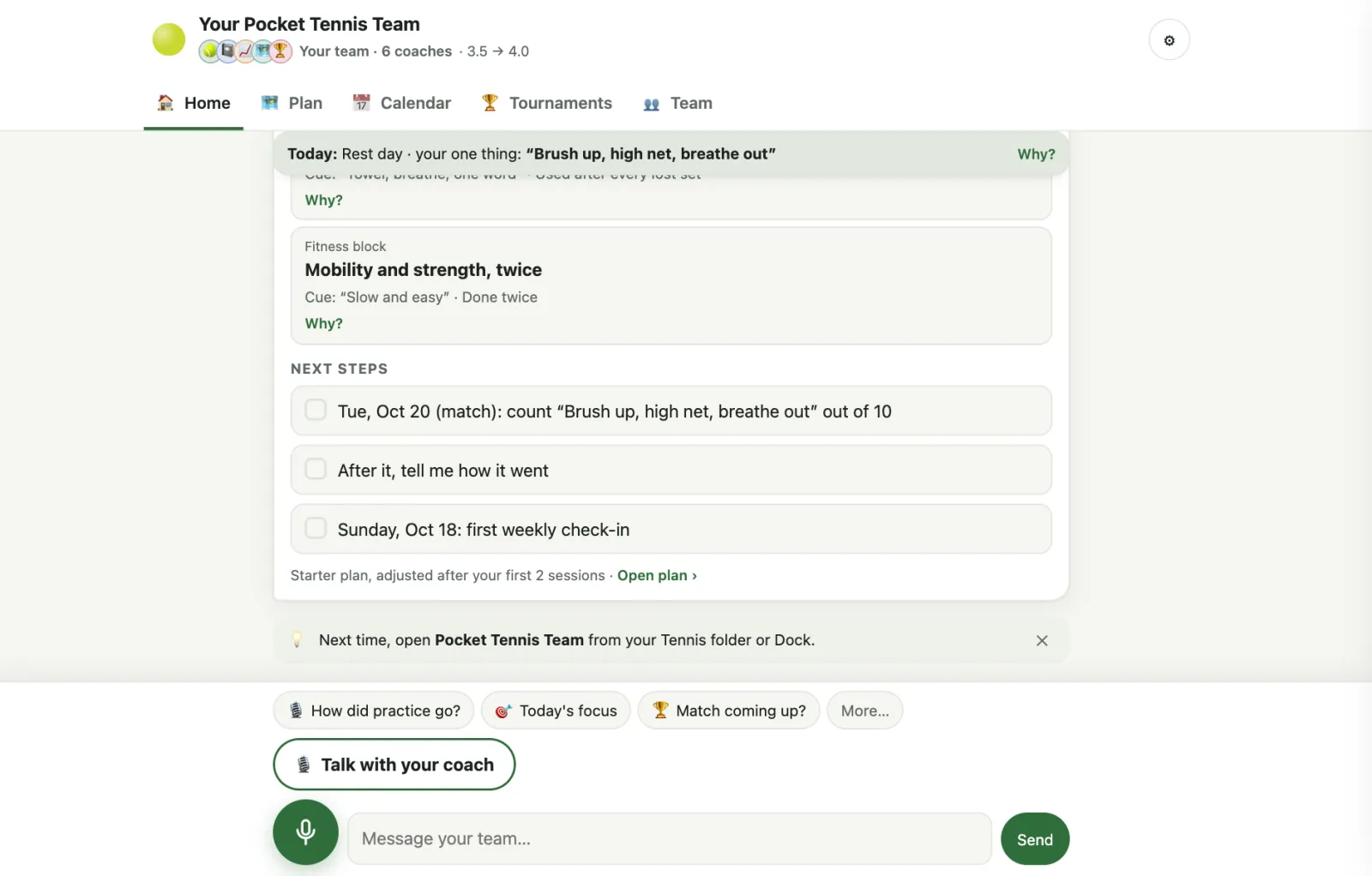
Conversation is the main surface, not charts. Each reply is signed by the team member who wrote it, so the player knows who decided what.
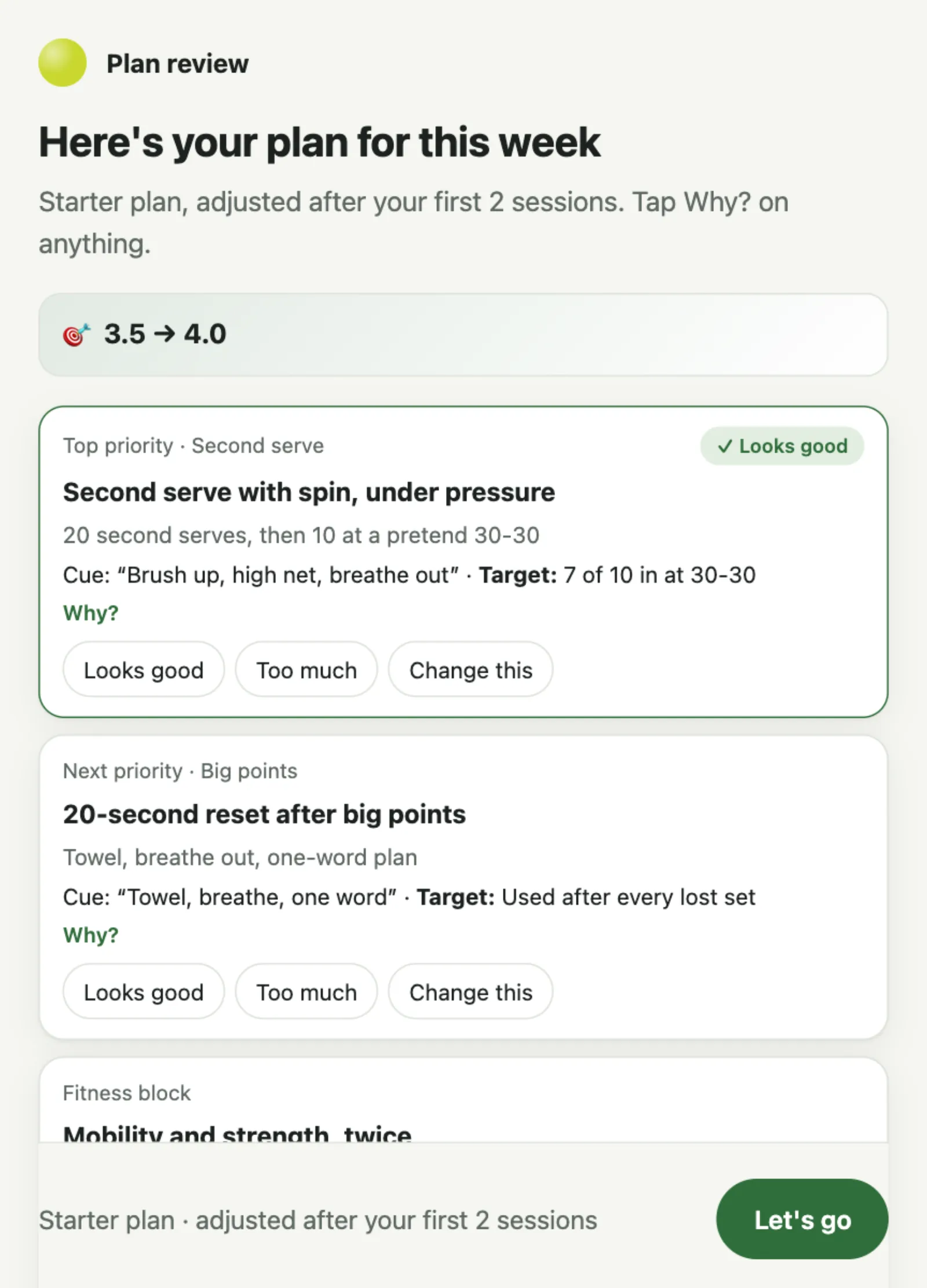
Every plan item has a Why
Each focus links to the player's own words, the member who decided it and a success target. A plan the player can't trace doesn't earn trust.
Small, honest load
At most three tennis focuses and one fitness block a week. That means saying no to bigger plans that would look more impressive.
One good session isn't proof
It takes repeated evidence to level up, so the plan changes slower than a chatbot would.
Health first
Tightness means monitor, pain pauses the related work, limping means stop now. Juniors get growth guardrails. Health guidance is labelled "not medical advice".
Private by default
Plain files in the player's own folder, and the app runs on their computer. Messages go to Claude for answers, with no cloud server or account of mine in between, even though that makes phone access harder.
Adults run it
Claude accounts are for adults, so a parent runs it for a junior. I cut the teen role until a policy review on minors.
Seven team members, each a Claude skill
I split a fuzzy job, coaching between lessons, into members with clear ownership of files and decisions. Replies are signed by the member who wrote them, and the player's real coach outranks videos and general tips. Player Scout, Fitness, Nutrition and Stats join later.
| Team member | What they do | Joins when |
|---|---|---|
| Head Coach | The front door. Listens to anything, answers fast, puts health first and calls in the right teammate. | Every message |
| Team Manager | Interviews the player and sets up the team folder and the starter plan. | First setup |
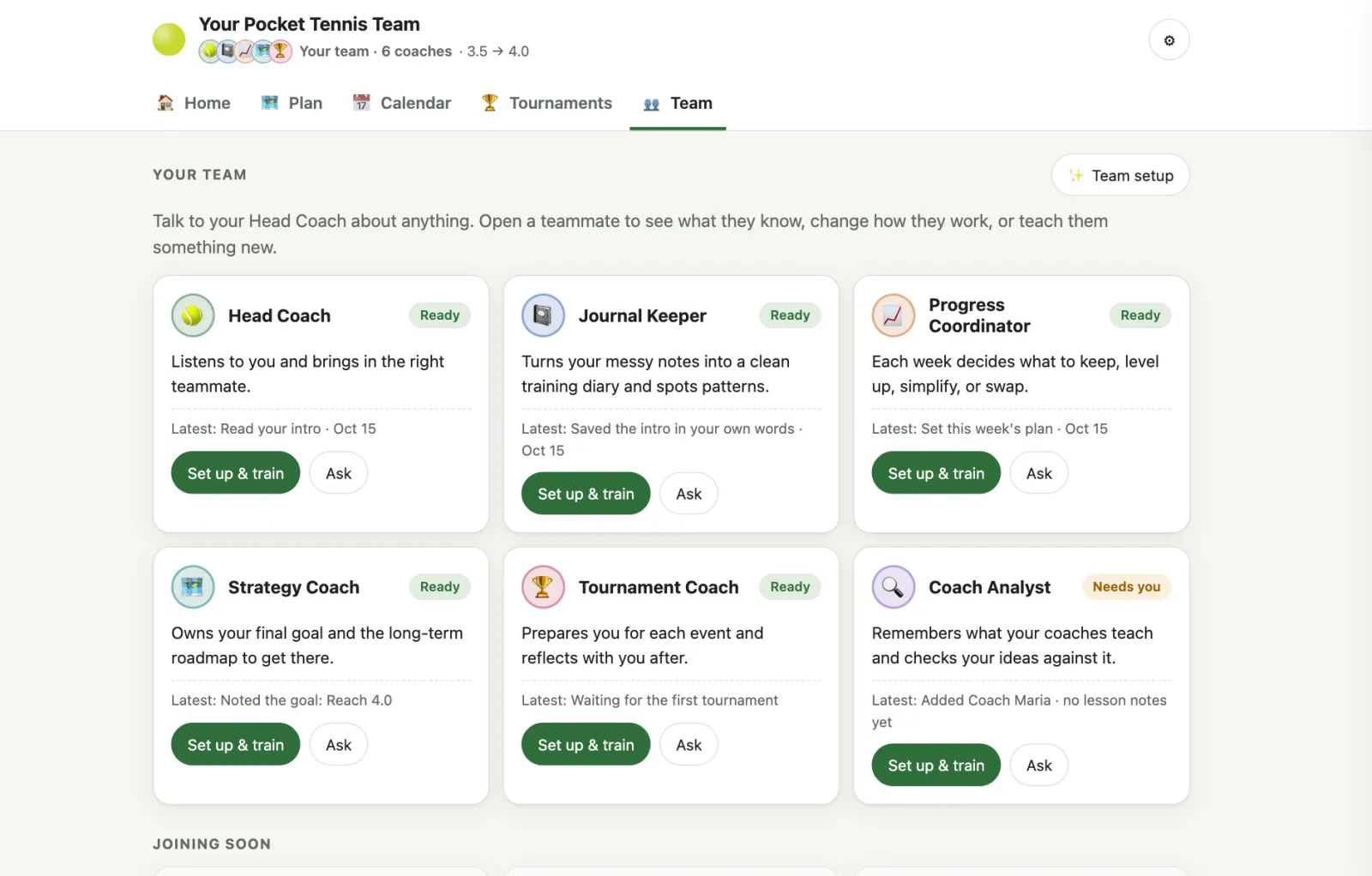
| Journal Keeper | Turns messy notes into a clean training diary and spots repeating patterns. | After practice or a match |
| Coach Analyst | Remembers what the player's real coach and favorite channels teach, and checks the player's ideas against it. | When a lesson or video comes in |
| Progress Coordinator | Each week decides what to keep, level up, simplify, rest or swap. | Weekly review |
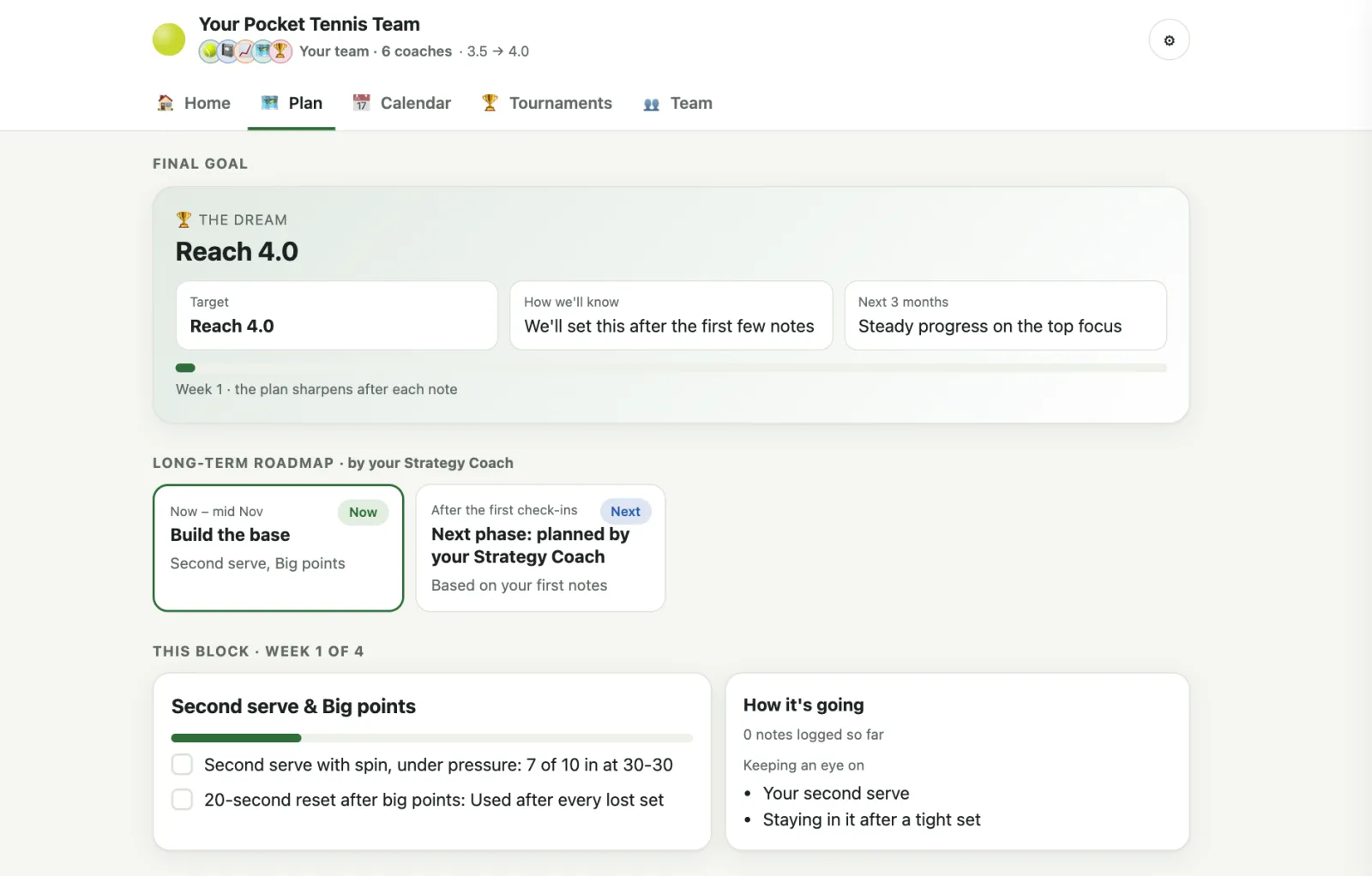
| Strategy Coach | Owns the final goal and the long-term roadmap to get there. | When the goal or roadmap changes |
| Tournament Coach | Handles the event calendar, entry deadlines, game plans, debriefs and reflections. | Around tournaments |
How it works
The app page talks to a local server on the player's computer, which runs Claude with the plugin's skills. The player's folder is the memory, and the app renders from one file, state.json. My first real test took minutes per message, so I split each message into two passes: the coach's reply time went from about 3 minutes to about 20 seconds in my own end-to-end tests with the live AI, and the bookkeeping now runs after the reply.
One message, two passes
- Claude gets file tools only (read, write, edit, search), never shell commands.
- The server listens only on 127.0.0.1, and every request needs a secret token.
- Health comes first: pain is always answered before anything else, and it pauses the related work.
- The player's files stay in their folder. Messages are processed by Claude, and voice goes through the browser's speech service.
A Claude plugin with seven skills and an auto-open hook, a small standard-library Python server, one HTML page, and Kokoro, an open-source voice model that runs on the device.
How I designed it, and what the tests changed
Personas and jobs
I wrote Sam and Mei and mapped their top tasks, from telling the coach how practice went to knowing what to say in the car.
Clickable prototypes, v1 to v3
I reviewed each version as product owner before wiring in the real AI, so the flow was settled before the model was.
Persona testing
AI agents role-played Sam and Mei through onboarding, daily training and tournaments over five rounds, while a designer agent fixed what they found.
Real end-to-end tests
Running the live AI changed the design: the two-pass reply, the natural voice and several safety fixes all came from these tests.
Smoothness scores out of 5 from AI agents role-playing each persona, not real players: 2 to 3 in the first test, 4 to 4.5 in the final round of five. Both persona agents' final verdict was "ready to show". Real players come next, in the friends beta.
| Persona | First test (v2) | Final test (v3) |
|---|---|---|
| Sam (adult player) | onboarding 3, daily 2, tournaments 2 | interview 4, plan review 4.5, home and daily 4.5, tournaments 4.5 |
| Mei (parent) | onboarding 3, daily 3, tournaments 2 | interview 4, plan review 4.5, family home 4.5, tournaments and health 4.5 |
Screens from the live demo
Live demo, sample data, in a desktop browser.
Where it stands
- Built: a v0.2 preview, tested end to end with the real AI and published on GitHub with a live demo.
- Not yet: used by real players, or tested on real devices such as the microphone and a fresh Mac. The app's own sorting of notes still uses keyword rules, while the coach's replies use Claude.
- Next, in order: real-device tests and a friends beta, then AI understanding and streaming replies, then phone capture and access. The name is the goal.
- Later: a go or no-go decision on a paid product. It's a gate, not a plan.